235-Year-Old Scottish Castle Near Edinburgh With Ties to Royalty
Seton Castle, built in 1789 by renowned architect Robert Adam, stands on the historic site of Seton Palace—once the favorite retreat of Mary, Queen of Scots—constructed using stones from the original palace.
The baronial Seton Castle, located just 12 miles from Edinburgh, offers an exceptional blend of historical significance and modern luxury.
Built in 1789 by renowned architect Robert Adam, the castle stands on the site of Seton Palace, once a favorite retreat of Mary, Queen of Scots. The original palace played host to some of the queen’s most pivotal moments, including her honeymoon with Lord Darnley. Stone from the palace was reused in the castle’s construction, preserving a tangible connection to Scotland’s royal past.
Set on 13 acres of private gardens and parkland, the castle is as functional as it is grand, boasting seven bedrooms and 18,000 square feet of living space. Its Neoclassical architecture features castellated turrets, secret staircases, and slit windows, while original elements like curved oak doors and arched windows have been carefully preserved.
Modern amenities blend seamlessly with its historic charm. Highlights include a billiards room, a 10,000-bottle wine cellar, a private bar, a cinema room, and recent upgrades such as a private gym and a helipad. For added privacy and versatility, the estate also includes three self-contained cottages and a romantic turret suite, aptly named "The Hideaway."
With its close proximity to Edinburgh, Seton Castle provides a tranquil retreat without compromising accessibility. It’s an extraordinary opportunity to own a piece of Scottish history.
All photos belong to the listing agency.
16th-Century Scottish Castle with Renowned Walled Gardens
Earlshall Castle is considered one of the best kept 16th century houses in Scotland, restored in the late 19th century by the prolific Scottish architect Sir Robert Lorimer.
Earlshall Castle was built by Sir William Bruce in 1546 and the castle has hosted British royalty for centuries, including Mary, Queen of Scots, and James VI of Scotland, who became James I of England.
The 50 foot painted ceiling in the Long Gallery depicts the coats of arms of European nobility, Scottish noble families and imaginary nobles. The Baron would sit beneath the royal coat of arms when holding Court to signify his power and direct tie to the King.
After the line of succession died out in 1708, the castle was sold in 1824 and fell into ruin until the end of the 19th century. In 1890, it was purchased by Robert Mackenzie, a bleach merchant from Perth. He hired his friend, the prolific Scottish architect Sir Robert Lorimer to restore the castle.
It was the first commission for the 26 year old, who restored the famous painted ceiling in the Long Gallery, originally painted by William, and Agnes Lindsay. Lorimer also designed its world famous walled garden featuring a grand topiary lawn which attracts visitors from around the world.
The castle boasts 10 bedrooms, 8 reception halls, and a grand dining room, as well as a library, billiards room and a gun room.
Earlshall Castle is considered one of the best kept 16th century houses in Scotland, although it is rumored to be haunted by the most notorious Baron of Earlshall, Sir Andrew Bruce—also know as ‘Bloody Bruce’ for his savagery during The Killing Time in the 17th century.
It is said his footsteps can be heard on the spiral staircase to this day…
The 53 acre estate includes several outbuildings, and a further 3 cottages.
In close proximity to the golf mecca of St. Andrews and only 50 miles from Edinburgh Airport.
All photos belong to the listing agency.
Historic Castle With Royal Ties Set in the Heart of Spain
Once owned by the Catholic Monarchs, this beautifully restored architectural marvel is a treasure trove of Spain's rich cultural heritage, just one hour from Madrid.
Offering panoramic views, the castle’s striking crenellated turrets, draped in ivy, rise dramatically from the rolling parkland, creating a picturesque silhouette that captures the imagination.
Nestled in the picturesque province of Segovia, a mere 75 km from the bustling city of Madrid, this extraordinary castle with an illustrious history awaits the new chapter in its storied existence.
This beautifully restored architectural marvel is a treasure trove of Spain's rich cultural heritage and is ideally positioned to create a spectacular luxury hotel in the Spanish countryside, just one hour from the capital.
Presently, the Spanish castle has 25 en-suite bedrooms as well as extensive reception rooms and conference facilities, and the picturesque property is frequently rented for weddings and private events.
The castle’s 5,950 m2 (64,045 ft2) built area is a testament to meticulous restoration, blending historical authenticity with modern comforts.
The Royal Lounge, with its opulent decor, provides a perfect space for relaxation, while the stunning central courtyard offers a serene environment for social gatherings.
The atmospheric library, filled with antiquarian books and artifacts, invites guests to immerse themselves in the castle's rich history.
In 1931, this magnificent edifice was declared a cultural landmark, cementing its status as a symbol of Spain's noble heritage.
Although its precise origins remain shrouded in mystery, historians believe there may have been a fortress on this site since the reign of Abd-al Rahman I in the eighth century.
The earliest sections of the current structure date back to the 12th and 13th centuries, showcasing a rich blend of Gothic-Mudejar architecture with traces of Moorish, Elizabethan, and Neo-Classical influences.
Over the centuries, the castle has been passed down through several of Spain's royal dynasties, including the Catholic Monarchs.
The castle was lived in by Queen Isabella I of Castile and King Ferdinand II of Aragon during their travels through the country, and at one point it was also the home of their daughter, Juana I of Castile.
Set on a sprawling 79-hectare (195-acre) estate with several swimming pools, the castle is surrounded by ancillary buildings that add to its charm and functionality.
A charming watermill, in excellent condition, offers the potential for a caretaker’s house or an activity centre. Several stone warehouses, currently used for exhibitions, provide versatile spaces for various uses.
The intriguing pyramidal folly and a lovely chapel on the estate present picturesque settings for weddings and other special events.
This extraordinary castle is not just a property; it’s a piece of Spain’s noble and colourful past. With its superb investment potential, it offers a once-in-a-lifetime opportunity to own a piece of history.
All photos belong to the listing agency.
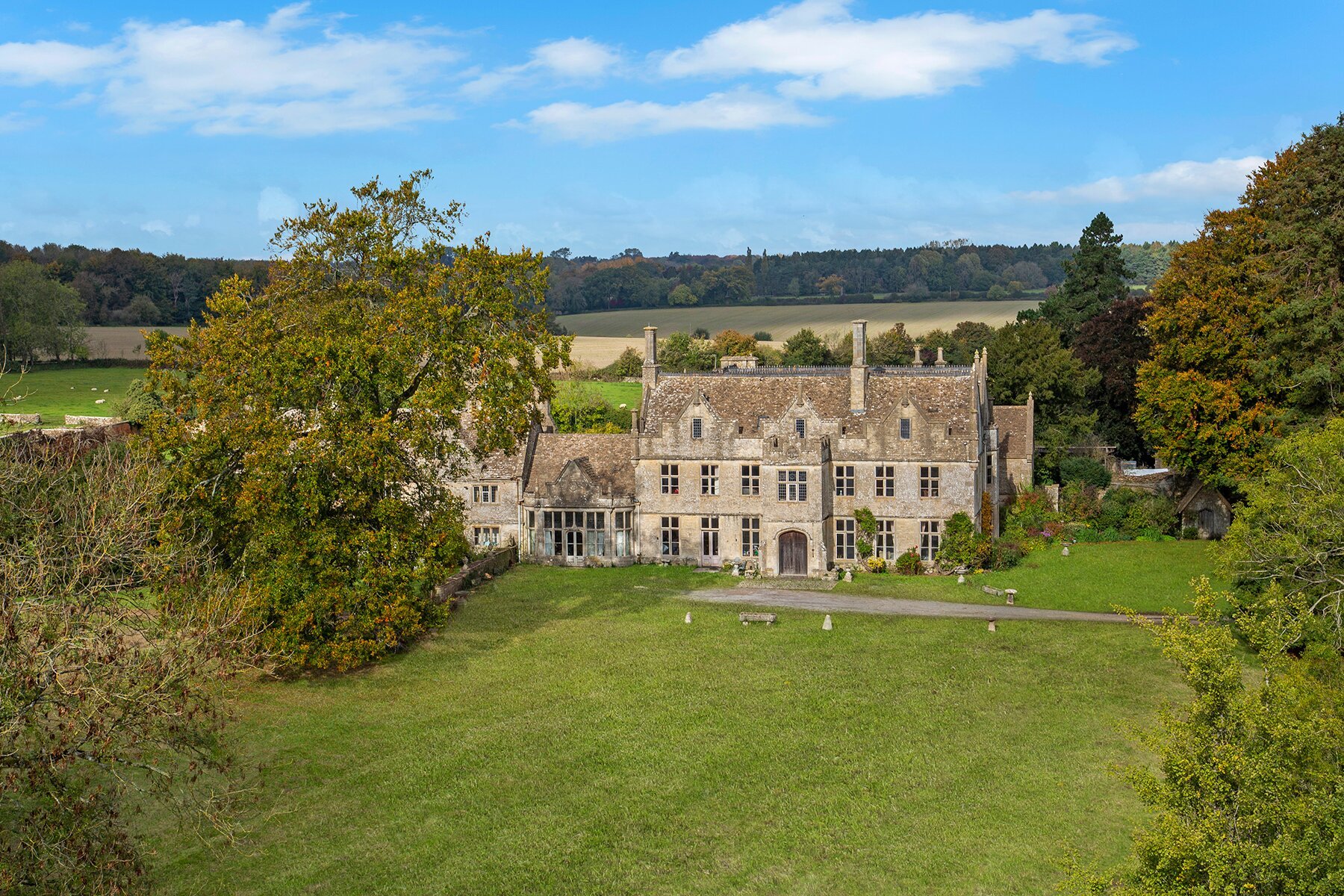
An Elizabethan Cotswolds Country Estate Next Door to High Grove
Elmestree House Estate neighbours High Grove, the famed country estate of Prince Charles, who purchased the 353-acre Gloucestershire home in 1980 and raised Princes William and Harry there.
Elmestree House Estate has an impressive address, right next door to royalty.
The 117 acre country estate is located within the Cotswold Area of Outstanding Natural Beauty and neighbours High Grove, the famed country estate of Prince Charles, who purchased the 353-acre Gloucestershire home in 1980 and raised Princes William and Harry there.
On the market for the first time in 72 years, the original estate dates back to the 12th century when it was given to the Benedictine monks.
The Grade II listed house was built in 1844 by William Brookes, with a wing added in 1884 connecting the Elizabethan country house to an adjacent 17th century farmhouse; further additions to Elmestree House were made in 1900.
The stately country house has 11 bedrooms, several grand reception rooms, and lovely period detail throughout, seen in the elegant cornicing, stone floors, and mullioned windows.
The farmhouse, connected by wing and with independent living accommodations, could be incorporated back with the main house or kept as a separate property.
The country estate has a 3-bedroom annex, a detached 2-bedroom cottage, and several outbuildings for a total of 19,000 square feet of space.
Elmestree House is nestled in the heart of a private estate in the coveted Cotswolds countryside, complete with walled gardens, ponds and a small boating lake, and acres of pasture and parkland.
Just 2 miles outside the prime market town of Tetbury, Elmestree House Estate presents a fantastic restoration project for the right buyer.
All photos belong to the listing agency.
A Muse, Mistress, and Patron of the Arts: The Story Behind Château de Menars
It’s any billionaire’s dream pad, but there is more to the story behind one of the few privately-owned châteaux in Loire Valley.
This property is listed for €15,750,000 by Val de Loire Sologne Sotheby's International Realty.
It’s any billionaire’s dream pad, but there is more to the story behind one of the few privately-owned châteaux in Loire Valley.
Château de Menars belonged to Edmond Baysari, a Lebanese-born, Monaco-based property developer with a passion for art, architecture, and history. Well into his 80s and without apparent heirs, the UNESCO-listed property was put on the market in 2017. Baysari passed away in 2018.
The price tag is a fraction of the €100M to restore it over 30 years, and he had hoped the property stays intact. It is rumoured he has turned down 9-figure deals from Russian Oligarchs and Middle Eastern billionaires.
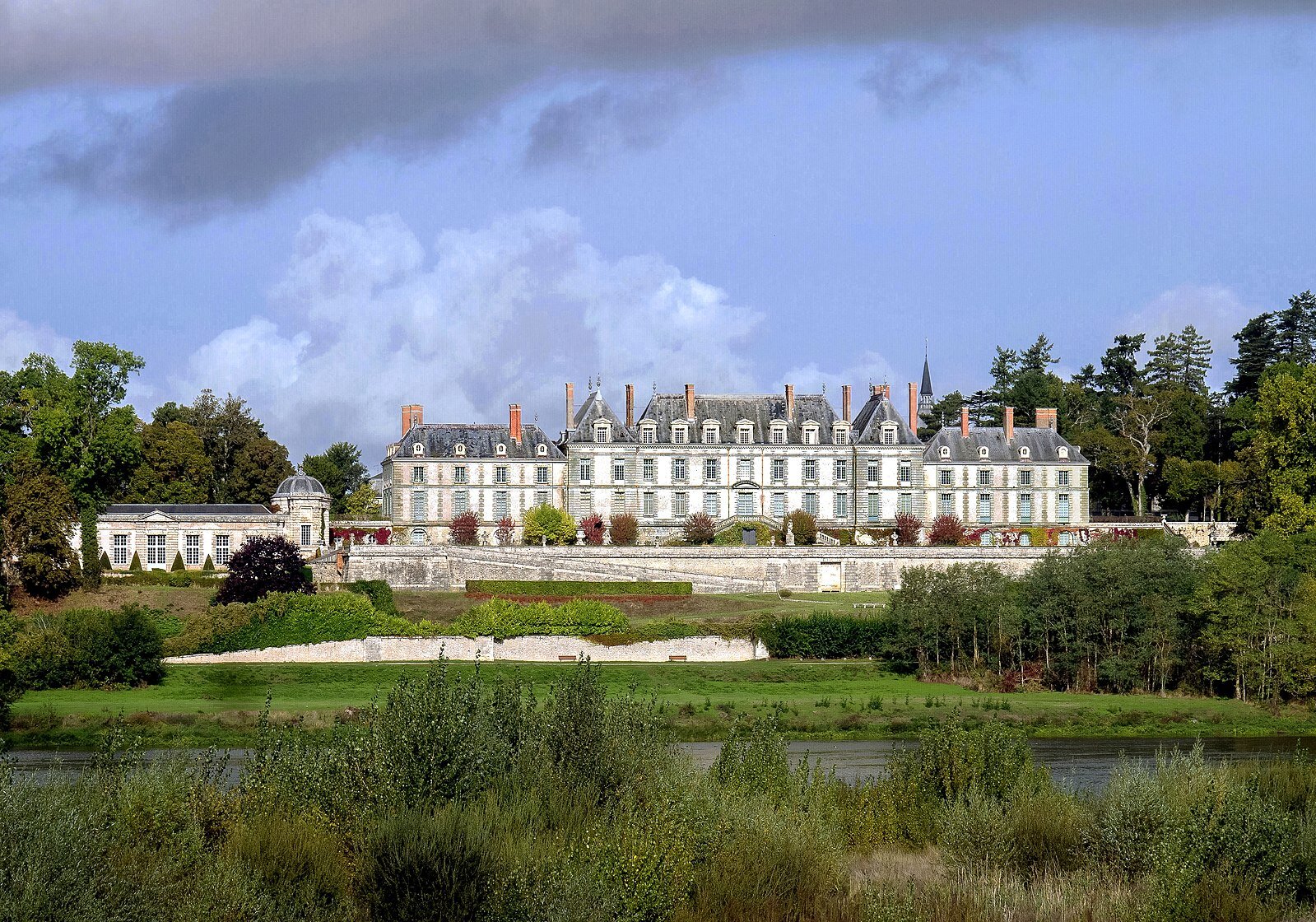
Château de Menars, (Starus via Wikimedia Commons)
The annual upkeep of the 50-bedroom château is roughly €400K. This includes the maintenance of lavish geometric gardens designed by famed landscape architect Le Nôtre, the principal gardener of King Louis XIV of France who also designed the gardens are Versailles.
The property boasts the longest avenue of century-old lime trees in Europe, stretching 4 km long. The terraces extend to the banks of the Loire, dotted with 18th century statues of Roman emperors. Vineyards on the property yield pinot noir and there is a 30,000 bottle wine cellar.
Baysari referred to his 130,000 square foot, 104-acre estate as "Palace Pompadour", after his muse.
The 30-year restoration project is a labour of love. "Very early I came across this woman in my readings, and I was immediately passionate about her," said Baysari, recalling when he first heard of Madame de Pompadour as a young child.
Château de Menars once belonged to Madame de Pompadour, the maîtresse-en-titre (Royal Mistress) of King Louis XV, a true Renaissance woman whose influence on art, style, and politics changed the world.
Detail from Madame de Pompadour, 1756, by François Boucher, Wikipedia
How can Madame de Pompadour be a ‘Renaissance woman’ when she was born in 1721? The term ‘Renaissance woman' (or man) was originally used to describe the qualities of a polymath from the Renaissance period.
A basic tenant of Renaissance humanism is that humans are limitless in their capacity for development. Leonardo da Vinci has often been described as the archetype of the Renaissance man, a man of "unquenchable curiosity" and "feverishly inventive imagination".
The term was first recorded in the early 20th century to refer to the qualities of Renaissance polymaths, although today it is commonly used to describe someone who has broad intellectual interests and is good at many things.
Baysari's lawyer, Jack Anderson, reportedly said "She was a Renaissance woman, and he was a Renaissance man”, when explaining Baysari’s fascination with Pompadour.
Born Jean Antoinette Poisson in 1721 to a promiscuous mother and a penniless father who fled the country to escape his debts, she was just four years old when she came under the legal guardianship of Jean Pâris de Montmartel. A wealthy tax collector who paid for her education, he was rumoured to be her biological father.
At the age of nine, her mother took her to a fortune teller who predicted she would “one day reign over the heart of the King”. Her destiny was sealed: from that time she was called “Reinette”, meaning "little queen". Her family set out to groom Jean Antoinette to become the mistress of Louis XV, and she was educated in dancing, drawing, painting, engraving, theatre, the arts, and attained the ability to memorize entire plays.
Even her marriage at 19 to her guardian’s nephew, Charles-Guillaume Le Normant d’Étiolles, did little to prevent her from fulfilling her destiny. Shortly after they wed, Jeanne-Antoinette and her husband acquired a château in Senart near Louis XV’s hunting lodge, where she would ride horseback on the King’s hunt days hoping to catch his eye.
In 1745, she received an invitation to a lavish masquerade at Versailles in celebration of the marriage of the Dauphin of France and Maria Theresa, Infanta of Spain.
Winners of Best Costume? Six gargantuan turbaned Turks are seen in this 1764 etching of the Yew Tree Ball in 1745, celebrating the marriage of Louis XV's son, Dauphin of France, and Maria Theresa, Infanta of Spain. Charles Nicolas Cochin, (The Met Museum)
Held in the Hall of Mirrors, there were 1,500 in attendance. Many were costumed in elaborate Turkish and Chinese costumes, reflecting the exoticism that was vogue in 1740s Paris. Jeanne-Antoinette arrived dressed as Diana, the Roman goddess of the hunt.
Louis XV, dressed as a topiary yew tree along with several servants alongside him, dramatically unmasked himself and finally declared his reciprocated feelings for her that night. That event came to be known as the Yew Tree Ball because of the King’s costume.
Within a month, she had abandoned her husband and daughter for the King. Given the title of the Marquise de Pompadour, she moved into a private apartment in the palace, with a private circular staircase giving her direct passage to the Kings chambers.
Madame Pompadour, by Francois Boucher (Wikimedia Commons)
The passionate nature of their relationship was no secret in court. The King allegedly moulded the traditional French champagne glass into the shape of one of her breasts; he also commissioned a diamond cut in the shape of her lips. The first of its kind, the cut became known as the Marquis cut, although it is also known as the “navette”.
Designed in the shape of the Marquise of Pompadours lips, the Marquis diamond cut, is also known as the navette cut.
After four years at court, Pompadour would even be elevated to lady-in-waiting to the Queen, the most noble rank possible for a woman at court. Madame de Pompadour got along so well with Queen Marie, that she allegedly remarked "If there must be a mistress, better her than any other."
Ultimately, she would became his trusted advisor, but she grew her influence over the king as a friend who enriched his life with gaiety and lightness. Before their relationship, the King’s main pastime was hunting. She would never tire of entertaining the easily bored royal, often writing and acting in plays for the King to uniquely showcase her wit and charm.
She expanded his worldview with books, art, and culture with her collections of object d’art: a “myriad of paintings, sculptures, and chinoiseries that Pompadour patronzized, commissioned, and collected” (It is said that the sale of her effects after her death lasted for more than a year.)
King Louis XV, Portrait by Maurice-Quentin de La Tour, 1748
Pompadour’s position in court was highly sexualized and highly politicized in a time when courtiers were openly vying for power and influence with Louis XV. The Marechale I de Mirepoix used to say to Madame de la Pompadour “It isn’t you he loves, it’s your staircase”, but their relationship was much more than just physical.
According to Columbia University art historian Susan Wager, "She was mediating between members of the court and the king. They would say 'I want to say this to the king.' And she'd say, 'No, wait, let me tell him. Let me translate it into my own words and I'll come back to you.' She was, in all sorts of ways, manipulating this idea of the staircase — of the passage — in an artistic, in an intellectual and in a political way.”
She is said to have declared unapologetically, "I am stubborn in the service of the King and I won't hold back in anything”, and “effectively played the role of prime minister, becoming responsible for appointing advancements, favours, and dismissals, and contributing in domestic and foreign politics”.
When the relationship changed in 1750 (diaries and letter report that Pompadour switched floors in Versailles), Wagner states "What's really remarkable is that she still remained at court in the position of official mistress for the rest of her life even though there was no longer a sexual relationship".
As the King’s mistress, Pompadour was no stranger to controversy. As a contemporary and friend of Voltaire, a thought leader of the Enlightenment, she was also outspoken about her beliefs as a champion of free thought.
She openly opposed the Catholic Church by supporting the creation of the French Encyclopedia, which discussed ideas of the Scientific Revolution. She made waves in political circles, ultimately influencing the King to break a Peace Treaty with Prussia and she was ultimately blamed for the brutal defeat in the following Seven Years War.
Pompadour’s influence on French society and culture was vast-reaching, and she is often credited with making Paris the capital of taste and culture in Europe. Her love of porcelain led to Louis XV purchasing a porcelain factory in Sèvres in 1759, giving her influence on styles and designs of Sèvres Porcelain. The Chief chemist of Sèvres, Jean Hellot, was enlisted to create the most beautiful pink color ever seen, a shade named “Rose Pompadour”.
She helped bring on the European Rococo movement with her influence of the Rocaille style used liberally in the decorative arts. The light-hearted, French Rococo style she championed became known as the Louis XV style. She would decorate and often redecorate the 15 residences she had with the King, and was known for being a patron of both Rococo artists and the greatest royal patron of portraiture. She commissioned many portraits from leading artists of the day, and was often involved in the composition and direction of the paintings, which was unusual for patrons in this time.
Madame de Pompadour by François Boucher, 1758.
In architecture, she sealed her influence when she elevated her brother Abel Poisson to the title of the Marquis de Marigny and gave him a new position as General Directeur des Batiments. An official government role, he worked alongside Madame de Pompadour and King Louis XV to plan and build several important French monuments and buildings, such as the École Militaire and the Place Louis XV – today the Place de la Concorde.
The Petit Trianon at Versailles via Wikimedia Commons
After hiring architect Anges-Jacques Gabriel to build the Petit Trianon in Versailles, in 1760 she enlisted his expertise for what would be her last great work at Menars: a residence all her own.
She purchased it herself after selling off the Château de Bellevue to the King for his daughters; other reports suggest she sold jewelry and pearls to pay for the first instalment of construction. The château de Menars was part of her arrangements, should she outlive Louis XV or be forced to leave court.
Château de Menars was originally built in 1642 and Pompadour had big plans to refurbish the castle and build her dream home, adding flanking wings to the main château. Unfortunately she would never see Menars complete: Jeanne-Antoinette died in 1764 from tuberculosis. She was 42.
Watercolor “portraitist” of houses, Nicolas Pérignon visited Château Menars and depicted what the palace would look like once complete (1761-64).
Her brother, the Marquis de Marigny, would finish the restoration, but the property would sit quietly for over two centuries. In 1980 the property belonged to Saint-Gobain, a Parisian glass making company who would use the château for company retreats. When the company was nationalized by the French government, they were forced to sell Menars.
That’s when Sotheby’s chairman Peter Wilson told Baysari about the sale. With a fortune amassed from a successful real estate career (he had retired at just 32), Edmond purchased the château for about €2M in 1983.
Born in Lebanon, then under French colonial rule, Baysari left for the Americas as a teenager. After receiving a Harvard education, Baysari opened a widely successful real estate business in Venezuela in the 1960s. He then returned to Harvard for a master’s degree in nuclear engineering, before ending up on Wall Street working as a consultant. After, he traveled the world and settled in Monaco as a full-time philanthropist, focused on the arts.
A close friend of Ronald Reagan, Baysari also contributed to the Art in Embassies program in 1990, an art sharing program between U.S. embassies. which would eventually grow into a worldwide network. The crowning achievement of his curatorship was undoubtedly Château de Menars.
U.S. President Ronald Reagan would visit Chateau de Menars for an informal summit with Soviet leader Mikhail Gorbachev, organized by Baysari. Other notable guests include Mick Jagger and Britain’s Prince Charles. Sir Gawain (Wikimedia Commons)
In 1989, Baysari finally “decided [he] wanted to make a gift to Madame de Pompadour and put it back to the way she would have it if alive today," employing the exact methods used in the mid-18th century to “revive” Menars.
Even with the €100M invested into the château, the ground-floor apartments that were once Madame de Pompadour’s bedrooms are still unrestored. "I don't want to do it. I don't think I'm qualified," says Baysari, "I would rather that when she comes back, she does it herself."
Baysari passed away in 2018 without a will. The sale of the property belongs to his estate is being managed by his niece and the Baysari group.
This incredible 100-acre estate is one of the largest châteaux on the market in the Loire Valley, and offers views looking over the Loire river. The property is being sold as a unique business opportunity for the right investor and includes an introduction to an international 5-star hotelier to develop the property. It’s an exciting project for an extravagant hotel complex in the most visited country in the world.
If you've enjoyed this article, please share it with a friend or post it on your social media:
Twitter | Facebook | LinkedIn.
Sources:
Articles:
Forbes, “France's $100 Million Palace Pompadour: A Royal Chateau Restored By A Press-Shy Philanthropist”, Morgan Brennan, 2013.
History Today, “Madame de Pompadour's Staircase”, Nancy Mitford, Published in History Today Volume 4 Issue 1 January 1954.
La Nouvelle Republique, “Ménars. Le propriétaire du château de Mme de Pompadour est décédé”, Catherine SIMON, 2018
NPR, “More Than A Mistress: Madame De Pompadour Was A Minister Of The Arts”, Sunsan Stamberg, 2016.
Reuters, “Labor of love French chateau on market for $30 million”, Johnny Cotton, 2017.
Books:
Goodman, Elise. “The portraits of Madame de Pompadour: Celebrating the Femme Savante” (Berkeley: University of California Press, 2000)
Hooper-Hamersley, Rosamond. “The Hunt After Jeanne-Antoinette de Pompadour: Patronage, Politics, Art, and the French Enlightenment” (Lexington Books, 2011)
A Muse, Mistress, and Patron of the Arts: The Story Behind Château de Menars
It’s any billionaire’s dream pad, but there is more to the story behind one of the few privately-owned châteaux in Loire Valley.
This property is listed for €31,500,000 byJean-Pierre Piganoil of Val de Loire Sologne Sotheby's International Realty Sothebys International Realty.
It’s any billionaire’s dream pad, but there is more to the story behind one of the few privately-owned châteaux in Loire Valley.
Château de Menars belonged to Edmond Baysari, a Lebanese-born, Monaco-based property developer with a passion for art, architecture, and history. Well into his 80s and without apparent heirs, the UNESCO-listed property was put on the market in 2017.
The €31.5M price tag is a fraction of the €100M he has put into restoring it over the past 30 years, and he is hoping the property stays intact. It is rumoured he has turned down 9-figure deals from Russian Oligarchs and Middle Eastern billionaires.
The sale handler, lawyer Jack Anderson is committed to Baysari’s goal: “to know that it’s in the hands of someone who’s going to continue the beauty of the chateau and maintain it”. Find the listing here.
Château de Menars, (Starus via Wikimedia Commons)
The annual upkeep of the 50-bedroom château is roughly €400K. This includes the maintenance of lavish geometric gardens designed by famed landscape architect Le Nôtre, the principal gardener of King Louis XIV of France who also designed the gardens are Versailles.
The property boasts the longest avenue of century-old lime trees in Europe, stretching 4 km long. The terraces extend to the banks of the Loire, dotted with 18th century statues of Roman emperors. Vineyards on the property yield pinot noir and there is a 30,000 bottle wine cellar.
Baysari referred to his 130,000 square foot, 104-acre estate as "Palace Pompadour", after his muse.
The 30-year restoration project is a labour of love. "Very early I came across this woman in my readings, and I was immediately passionate about her," says Baysari, recalling when he first heard of Madame de Pompadour as a young child.
Château de Menars once belonged to Madame de Pompadour, the maîtresse-en-titre (Royal Mistress) of King Louis XV, a true Renaissance woman whose influence on art, style, and politics changed the world.
Detail from Madame de Pompadour, 1756, by François Boucher, Wikipedia
How can Madame de Pompadour be a ‘Renaissance woman’ when she was born in 1721? The term ‘Renaissance woman' (or man) was originally used to describe the qualities of a polymath from the Renaissance period.
A basic tenant of Renaissance humanism is that humans are limitless in their capacity for development. Leonardo da Vinci has often been described as the archetype of the Renaissance man, a man of "unquenchable curiosity" and "feverishly inventive imagination".
The term was first recorded in the early 20th century to refer to the qualities of Renaissance polymaths, although today it is commonly used to describe someone who has broad intellectual interests and is good at many things.
Baysari's lawyer, Jack Anderson, reportedly said "She was a Renaissance woman, and he was a Renaissance man”, when explaining Baysari’s fascination with Pompadour.
Born Jean Antoinette Poisson in 1721 to a promiscuous mother and a penniless father who fled the country to escape his debts, she was just four years old when she came under the legal guardianship of Jean Pâris de Montmartel. A wealthy tax collector who paid for her education, he was rumoured to be her biological father.
At the age of nine, her mother took her to a fortune teller who predicted she would “one day reign over the heart of the King”. Her destiny was sealed: from that time she was called “Reinette”, meaning "little queen". Her family set out to groom Jean Antoinette to become the mistress of Louis XV, and she was educated in dancing, drawing, painting, engraving, theatre, the arts, and attained the ability to memorize entire plays.
Even her marriage at 19 to her guardian’s nephew, Charles-Guillaume Le Normant d’Étiolles, did little to prevent her from fulfilling her destiny. Shortly after they wed, Jeanne-Antoinette and her husband acquired a château in Senart near Louis XV’s hunting lodge, where she would ride horseback on the King’s hunt days hoping to catch his eye.
In 1745, she received an invitation to a lavish masquerade at Versailles in celebration of the marriage of the Dauphin of France and Maria Theresa, Infanta of Spain.
Winners of Best Costume? Six gargantuan turbaned Turks are seen in this 1764 etching of the Yew Tree Ball in 1745, celebrating the marriage of Louis XV's son, Dauphin of France, and Maria Theresa, Infanta of Spain. Charles Nicolas Cochin, (The Met Museum)
Held in the Hall of Mirrors, there were 1,500 in attendance. Many were costumed in elaborate Turkish and Chinese costumes, reflecting the exoticism that was vogue in 1740s Paris. Jeanne-Antoinette arrived dressed as Diana, the Roman goddess of the hunt.
Louis XV, dressed as a topiary yew tree along with several servants alongside him, dramatically unmasked himself and finally declared his reciprocated feelings for her that night. That event came to be known as the Yew Tree Ball because of the King’s costume.
Within a month, she had abandoned her husband and daughter for the King. Given the title of the Marquise de Pompadour, she moved into a private apartment in the palace, with a private circular staircase giving her direct passage to the Kings chambers.
Madame Pompadour, by Francois Boucher (Wikimedia Commons)
The passionate nature of their relationship was no secret in court. The King allegedly moulded the traditional French champagne glass into the shape of one of her breasts; he also commissioned a diamond cut in the shape of her lips. The first of its kind, the cut became known as the Marquis cut, although it is also known as the “navette”.
Designed in the shape of the Marquise of Pompadours lips, the Marquis diamond cut, is also known as the navette cut.
After four years at court, Pompadour would even be elevated to lady-in-waiting to the Queen, the most noble rank possible for a woman at court. Madame de Pompadour got along so well with Queen Marie, that she allegedly remarked "If there must be a mistress, better her than any other."
Ultimately, she would became his trusted advisor, but she grew her influence over the king as a friend who enriched his life with gaiety and lightness. Before their relationship, the King’s main pastime was hunting. She would never tire of entertaining the easily bored royal, often writing and acting in plays for the King to uniquely showcase her wit and charm.
She expanded his worldview with books, art, and culture with her collections of object d’art: a “myriad of paintings, sculptures, and chinoiseries that Pompadour patronzized, commissioned, and collected” (It is said that the sale of her effects after her death lasted for more than a year.)
King Louis XV, Portrait by Maurice-Quentin de La Tour, 1748
Pompadour’s position in court was highly sexualized and highly politicized in a time when courtiers were openly vying for power and influence with Louis XV. The Marechale I de Mirepoix used to say to Madame de la Pompadour “It isn’t you he loves, it’s your staircase”, but their relationship was much more than just physical.
According to Columbia University art historian Susan Wager, "She was mediating between members of the court and the king. They would say 'I want to say this to the king.' And she'd say, 'No, wait, let me tell him. Let me translate it into my own words and I'll come back to you.' She was, in all sorts of ways, manipulating this idea of the staircase — of the passage — in an artistic, in an intellectual and in a political way.”
She is said to have declared unapologetically, "I am stubborn in the service of the King and I won't hold back in anything”, and “effectively played the role of prime minister, becoming responsible for appointing advancements, favours, and dismissals, and contributing in domestic and foreign politics”.
When the relationship changed in 1750 (diaries and letter report that Pompadour switched floors in Versailles), Wagner states "What's really remarkable is that she still remained at court in the position of official mistress for the rest of her life even though there was no longer a sexual relationship".
As the King’s mistress, Pompadour was no stranger to controversy. As a contemporary and friend of Voltaire, a thought leader of the Enlightenment, she was also outspoken about her beliefs as a champion of free thought.
She openly opposed the Catholic Church by supporting the creation of the French Encyclopedia, which discussed ideas of the Scientific Revolution. She made waves in political circles, ultimately influencing the King to break a Peace Treaty with Prussia and she was ultimately blamed for the brutal defeat in the following Seven Years War.
Pompadour’s influence on French society and culture was vast-reaching, and she is often credited with making Paris the capital of taste and culture in Europe. Her love of porcelain led to Louis XV purchasing a porcelain factory in Sèvres in 1759, giving her influence on styles and designs of Sèvres Porcelain. The Chief chemist of Sèvres, Jean Hellot, was enlisted to create the most beautiful pink color ever seen, a shade named “Rose Pompadour”.
She helped bring on the European Rococo movement with her influence of the Rocaille style used liberally in the decorative arts. The light-hearted, French Rococo style she championed became known as the Louis XV style. She would decorate and often redecorate the 15 residences she had with the King, and was known for being a patron of both Rococo artists and the greatest royal patron of portraiture. She commissioned many portraits from leading artists of the day, and was often involved in the composition and direction of the paintings, which was unusual for patrons in this time.
Madame de Pompadour by François Boucher, 1758.
In architecture, she sealed her influence when she elevated her brother Abel Poisson to the title of the Marquis de Marigny and gave him a new position as General Directeur des Batiments. An official government role, he worked alongside Madame de Pompadour and King Louis XV to plan and build several important French monuments and buildings, such as the École Militaire and the Place Louis XV – today the Place de la Concorde.
The Petit Trianon at Versailles via Wikimedia Commons
After hiring architect Anges-Jacques Gabriel to build the Petit Trianon in Versailles, in 1760 she enlisted his expertise for what would be her last great work at Menars: a residence all her own.
She purchased it herself after selling off the Château de Bellevue to the King for his daughters; other reports suggest she sold jewelry and pearls to pay for the first instalment of construction. The château de Menars was part of her arrangements, should she outlive Louis XV or be forced to leave court.
Château de Menars was originally built in 1642 and Pompadour had big plans to refurbish the castle and build her dream home, adding flanking wings to the main château. Unfortunately she would never see Menars complete: Jeanne-Antoinette died in 1764 from tuberculosis. She was 42.
Watercolor “portraitist” of houses, Nicolas Pérignon visited Château Menars and depicted what the palace would look like once complete (1761-64).
Her brother, the Marquis de Marigny, would finish the restoration, but the property would sit quietly for over two centuries. In 1980 the property belonged to Saint-Gobain, a Parisian glass making company who would use the château for company retreats. When the company was nationalized by the French government, they were forced to sell Menars.
That’s when Sotheby’s chairman Peter Wilson told Baysari about the sale. With a fortune amassed from a successful real estate career (he had retired at just 32), Edmond purchased the château for about €2M in 1983.
Born in Lebanon, then under French colonial rule, Baysari left for the Americas as a teenager. After receiving a Harvard education, Baysari opened a widely successful real estate business in Venezuela in the 1960s. He then returned to Harvard for a master’s degree in nuclear engineering, before ending up on Wall Street working as a consultant. After, he traveled the world and settled in Monaco as a full-time philanthropist, focused on the arts.
A close friend of Ronald Reagan, Baysari also contributed to the Art in Embassies program in 1990, an art sharing program between U.S. embassies. which would eventually grow into a worldwide network. The crowning achievement of his curatorship was undoubtedly Château de Menars.
U.S. President Ronald Reagan would visit Chateau de Menars for an informal summit with Soviet leader Mikhail Gorbachev, organized by Baysari. Other notable guests include Mick Jagger and Britain’s Prince Charles. Sir Gawain (Wikimedia Commons)
In 1989, Baysari finally “decided [he] wanted to make a gift to Madame de Pompadour and put it back to the way she would have it if alive today," employing the exact methods used in the mid-18th century to “revive” Menars.
Even with the €100M invested into the château, the ground-floor apartments that were once Madame de Pompadour’s bedrooms are still unrestored. "I don't want to do it. I don't think I'm qualified," says Baysari, "I would rather that when she comes back, she does it herself."
Baysari passed away in 2018 without a will. The sale of the property belongs to his estate is being managed by his niece and the Baysari group.
This incredible 100-acre estate is one of the largest châteaux on the market in the Loire Valley, and offers views looking over the Loire river. The property is being sold as a unique business opportunity for the right investor and includes an introduction to an international 5-star hotelier to develop the property. It’s an exciting project for an extravagant hotel complex in the most visited country in the world.
If you've enjoyed this article, please share it with a friend or post it on your social media:
Twitter | Facebook | LinkedIn.
Sources:
Articles:
Forbes, “France's $100 Million Palace Pompadour: A Royal Chateau Restored By A Press-Shy Philanthropist”, Morgan Brennan, 2013.
History Today, “Madame de Pompadour's Staircase”, Nancy Mitford, Published in History Today Volume 4 Issue 1 January 1954.
La Nouvelle Republique, “Ménars. Le propriétaire du château de Mme de Pompadour est décédé”, Catherine SIMON, 2018
NPR, “More Than A Mistress: Madame De Pompadour Was A Minister Of The Arts”, Sunsan Stamberg, 2016.
Reuters, “Labor of love French chateau on market for $30 million”, Johnny Cotton, 2017.
Books:
Goodman, Elise. “The portraits of Madame de Pompadour: Celebrating the Femme Savante” (Berkeley: University of California Press, 2000)
Hooper-Hamersley, Rosamond. “The Hunt After Jeanne-Antoinette de Pompadour: Patronage, Politics, Art, and the French Enlightenment” (Lexington Books, 2011)