Tuscan Villa Near Lucca Once Owned by Napoleon’s Sister Hits the Market

In the hills outside Lucca, one of Tuscany’s grand historic estates has returned to the market with provenance few properties can match, acquired in 1836 by Caroline Bonaparte—Napoleon Bonaparte’s younger sister and Queen Consort of Naples.

In the hills outside Lucca, one of Tuscany’s grand historic estates has come to market through Lionard Luxury Real Estate, offering a provenance few properties can match. Price is disclosed upon application with the listing agency.

Known as Villa Orsucci, the 18th-century residence was acquired in 1836 by Caroline Bonaparte —Napoleon Bonaparte’s younger sister and Queen Consort of Naples—cementing the villa’s direct royal lineage.

Watch the tour below

The estate traces its origins to the 16th century but was transformed in the early 1700s by silk merchant Coriolano Orsucci, who invited Filippo Juvarra—renowned Baroque architect of Turin’s Basilica of Superga and the Palazzina di Caccia di Stupinigi (Stupinigi Hunting Lodge) for the Savoy dynasty—to redesign and expand the property. Only parts of his vision were realized; Juvarra’s full Baroque plans for a monumental portal and ornate gardens were never executed due to Orsucci’s death, leaving the villa as a Lucchese country residence distinguished by Baroque elements rather than a complete Baroque composition.

In 1836, the villa passed into the hands of Caroline Bonaparte. By then, Napoleon himself had been dead for 15 years, exiled to St. Helena after Waterloo in 1815. Caroline, who had reigned in Naples alongside her husband Joachim Murat, returned to Italy following the collapse of the empire and lived between Florence and the Tuscan countryside.

Napoleon is often said to have remarked of his sister, “Of all my family, she is the one that resembles me the most.”

Securing Villa Orsucci in her final years underscored the Bonaparte family’s enduring presence in Italy, even after their fall from imperial power—a legacy that continues to resonate in today’s market.

Today, the villa spans more than 2,500 square meters (≈26,900 sq ft) across three principal floors, an attic, and a basement. Its centerpiece is a double-height salon—measuring 125 square meters (≈1,345 square feet) and rising 8 meters (≈26 feet) high—the largest among Lucca’s villas, decorated with elaborate stuccos and two monumental canvases by Pier Dandini, a leading Florentine Baroque painter active in the late 17th and early 18th century.

Period-furnished reception halls, the celebrated red room with silk-covered walls, restored historic kitchens, and a vaulted wine cellar reinforce the villa’s standing as a preserved cultural landmark. Beyond the main residence, the estate includes a five-bedroom guesthouse, a private 18th-century chapel, and a 200-square-meter (≈2,153-square-foot) lemon house that shelters more than 100 citrus trees each winter and doubles as an event venue.

The grounds extend across six hectares (≈14.8 acres) of parkland, olive groves, and meadows, lined with centuries-old vegetation, boxwood hedges, and terracotta statues. Two swimming pools are operational, a third is approved, and a heliport can be added.

The estate is located above 20 miles from Pisa International Airport and just a few miles from Lucca-Tassignano Airport, which services private aviation.

For Lionard founder and CEO Dimitri Corti, the estate represents more than a rare Tuscan villa. “The global market is no longer just looking for luxury; it’s looking for unique pieces of history, and Villa Orsucci is exactly that,” Corti said. “The buyer isn’t just acquiring walls and frescoes; they are taking ownership of the last available chapter of a legend…an investment in an eternal brand: Napoleon Bonaparte.”

That framing resonates beyond Tuscany. An auction earlier this year of more than 100 Napoleonic objects—including one of his iconic bicorn hats—brought in roughly €8.7 million against estimates of €6–7 million decisively beating expectations. More than two centuries after Waterloo, interest in Napoleon and his circle is only gaining momentum—and Villa Orsucci, secured by his sister Caroline in her final years, sits firmly within that trajectory.

All images courtesy of Lionard Luxury Real Estate.

Read More

1800s French Manor House in the Jura Wine Region Asks €636,000

The property offers both scale and charming setting in a region gaining international attention for its wines and landscapes.

This 19th-century maison de maître is on the market for €636,000 in Montmorot. Listed with Arrière-Cour Immobilier, it’s two minutes from Lons-le-Saunier—the capital of the Jura region in eastern France.

A maison de maître (literally “master’s house”) is a type of large, elegant townhouse that was typically built in France and Belgium during the 18th and 19th centuries for the wealthy bourgeoisie, landowners or industrialists.

The residence spans 504 m² (5,425 ft²) across 15 rooms; 5 bedrooms, 3 baths. Inside, original elements remain in place—parquet and terracotta floors, wood paneling, fireplaces, and wrought-iron details. There are also vaulted cellars and convertible attic space.

The property offers both scale and charming setting in a region gaining international attention for its wines and landscapes.

Set on 1.5 hectares (3.7 acres) of enclosed parkland, the house overlooks the rooftops of Lons-le-Saunier and the Jura hills. Several outbuildings, including an orangery, barn, greenhouse, stables, and horse boxes, extend the potential for equestrian, hospitality, or multi-unit residential use.

While in need of partial renovation, the manor offers a solid architectural framework and a rare opportunity to reimagine a historic estate at the edge of town.

Once overshadowed by Burgundy, the Jura has emerged as a rising star in the wine world. Its vineyards, from Arbois to Château-Chalon, produce characterful wines—Savagnin, Vin Jaune, Poulsard—that have become fixtures on international lists.

Nearby, Baume-les-Messieurs—classified among the “Most Beautiful Villages of France”—sits in a dramatic valley setting, while Salins-les-Bains and Lons-le-Saunier continue the region’s historic spa culture. Outdoor pursuits are never far: the Jura’s rolling hills, lakes, and forests support hiking, cycling, and winter sports, all within easy reach of Geneva, Lyon, and Dijon.

For buyers seeking a foothold in an ascendant region, this maison de maître balances accessibility, heritage, and potential at an accessible price point.

All photos belong to the listing agency.

Read More

Lake Como Villa — Private Dock, Infinity Pool, & Custom Speedboat

Between Como and Bellagio, opposite George Clooney’s Villa Oleandra, this secluded lakeside retreat captures the spirit of la Dolce Vita, sold complete with bespoke furnishings and customized Riva Aquariva Super.

On the market with Exclusive RE — Christie's International Real Estate, Villa Matilda merges architectural precision with lakeside seclusion, perched on the eastern shores of Lake Como, between Como and Bellagio, directly facing George Clooney's Villa Oleandra.

Featured by AD Italia in 2024, the estate pairs contemporary interiors by Filippo Fiora and Federico Sigali of Studio 13.1 with a rare pieds dans l’eau setting — a private waterfront retreat accessible directly from the lake or via a discreet hillside path hidden from view.

Located in Pognana Lario, a secluded village known for its cobbled streets, intimate hamlet ambiance, and enduring sense of privacy, the villa enjoys a rare combination of tranquility and proximity to Como’s historic center and Bellagio’s storied charm. The eastern shore’s sunlit orientation and unspoiled vistas have long made it one of the most desirable stretches of Lake Como, with prime waterfront properties holding their value in a market driven by global demand for discreet luxury retreats.

Designed as a personal commission by the now-former owners, the brief to the architects was clear: create a villa that balanced beauty with function; a contemporary home built for both privacy and year-round living. The main villa spans approximately 260 sqm (2,800 sq ft) arranged over two floors, with three bedrooms and light-filled interiors that balance contemporary elegance with understated detail. The restored lemon house serves as a guest annex, bringing the total to six bedrooms across the estate. An elevator discreetly links all three levels, connecting the living areas with the underground private dock.

With its main entrance from the lake and only a discreet hillside path connecting to the road above, Villa Matilda feels every bit the secluded lakeside retreat it was designed to be. Outside, a heated infinity pool blurs into the lake’s horizon, set within a contemporary garden layered with classical elements: statues, clipped box hedges, and a restored lemon house converted into a guest annex.

Villa Matilda is offered fully furnished and complete with a customized Riva Aquariva Super, a collector’s speedboat crafted by Italy’s legendary Riva shipyard. The Aquariva Super remains a symbol of la Dolce Vita, once favored by icons like Sophia Loren and Alain Delon on the lakes and rivieras of Italy.

Villa Matilda stands among the rare few Lake Como properties that combine direct water access, privacy, and architectural pedigree — a turnkey estate that captures the understated luxury of the Italian Dolce Vita.

Price is disclosed upon application with the listing agency.

All photos belong to the listing agency.

Read More

An Old Quarry Is Now a Private Pool with a Waterfall in the Berkshires

Listed for $3.25M, this 60-acre estate comes with a waterfall-fed swimming pool carved into a limestone quarry—hidden deep in the Massachusetts woods.
In the wooded hills near Sheffield, Massachusetts—where the Berkshires taper toward the Connecticut line—sits a 60-acre estate with a pool unlike anything else on the market, listed with Jared Kelly and Elle Villetto of William Pitt Sotheby's International Realty.

Carved directly into an old limestone quarry, the 40-foot heated swimming pool features a 16-foot recirculating waterfall and is entirely hidden from view. It’s less a backyard feature, more a sculptural retreat embedded in the land.

Originally a working quarry, the site was reclaimed and reimagined by Aqua Pool & Patio to preserve the raw stone while integrating a modern, self-cleaning system. Excavation revealed four feet of debris at the bottom—much of it removed by hand. Twenty built-in cleaning nozzles now keep the water pristine with minimal maintenance. The pool holds roughly 15,000 gallons and ranges from three to seven feet deep, framed by vertical stone walls still etched with old wire-drill lines. What began as overgrowth and rubble was transformed into something quietly extraordinary.

The 3,459-square-foot home is quietly refined. A vaulted Great Room with exposed beams and French doors opens to a screened porch suspended in the trees. The kitchen features marble countertops, a farmhouse sink, and custom cabinetry that flows into the dining area. The main-level primary suite includes a spa-style bath, sitting area, and direct garden access. Three additional bedrooms, including one en suite, sit on the lower level along with a bright exercise or studio space.

Throughout the home, materials are left to speak for themselves—stone, wood, and glass used sparingly but deliberately. Sightlines are long, finishes are quiet, and nearly every room connects to the outdoors.

There’s space to build more if you want it. But the land already offers what most builds can’t: total privacy, visual impact, and a landscape you couldn’t recreate if you tried.

It’s a modest home on a valuable piece of land—but it’s the quarry that makes it unforgettable.

All photos belong to the listing agency.

Read More

18th-Century Bastide Near Gordes: The South of France You Dream About

At the gateway to the Luberon, this 15-acre estate in Le Thor—just 15 miles from Gordes—includes a restored 18th-century bastide and guest houses, with interiors featured in France’s top design magazines.

Set just 15 miles from Gordes, in the quiet village of Le Thor, this 15-acre (6.3-hectare) estate captures Provence at its most authentic—sun-baked, stone-built, and deeply connected to the region’s design heritage. Once home to a leading figure in French interiors, the bastide has appeared in several of the country’s top design publications. And it shows.

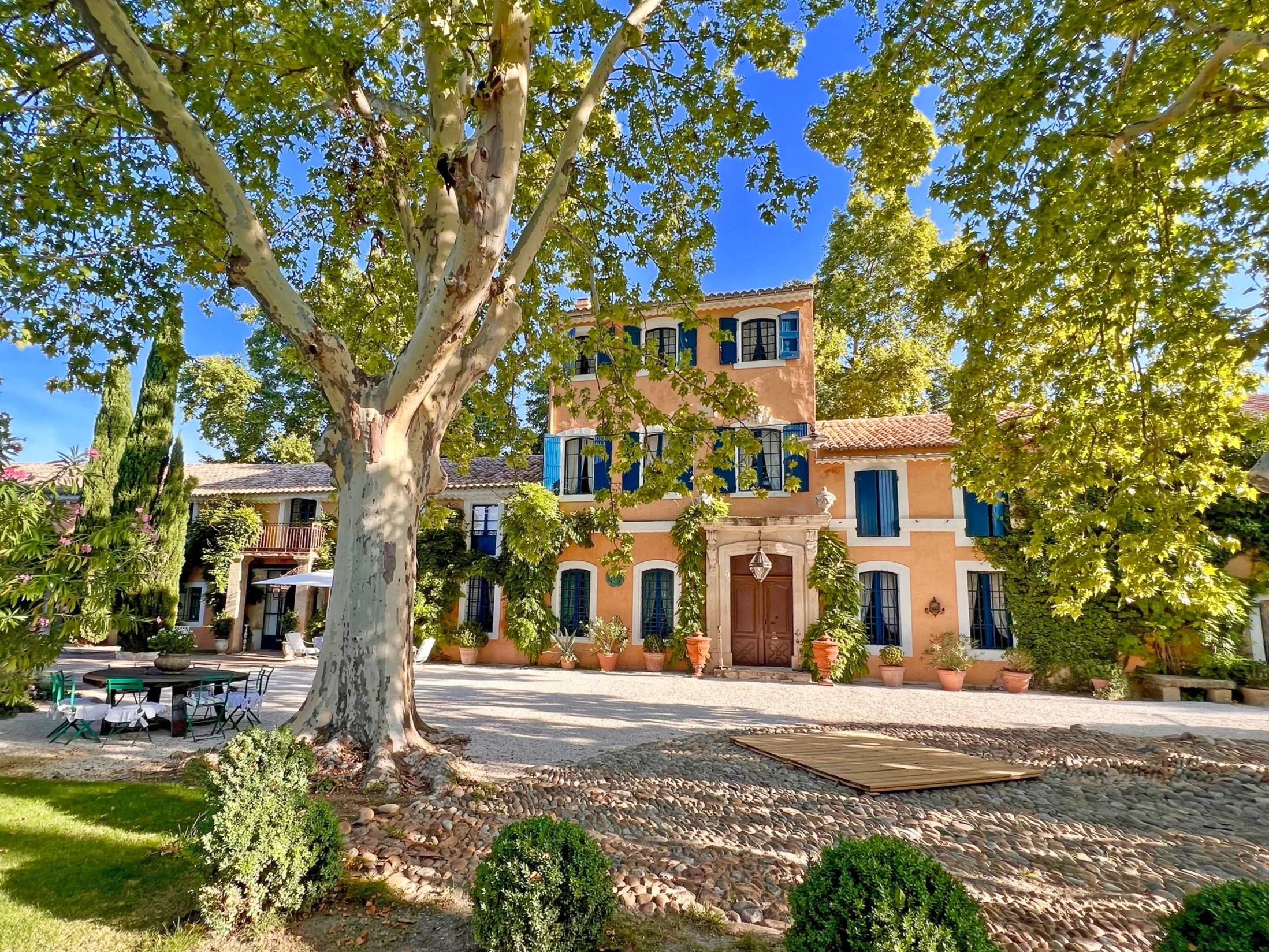
The estate reveals itself behind a cypress- and olive-lined drive, where a terracotta-hued main house with powder-blue shutters anchors nearly 15,000 sq ft (1,400 sq m) of living space across the bastide, guest houses, and outbuildings. Originally built as an 18th-century hunting lodge, the bastide was fully restored in 2018. Interiors strike a confident balance—sculptural fireplaces, exposed beams, and a semi-professional kitchen are paired with modern touches that feel curated, not staged.

The layout offers rare flexibility. The main house includes four south-facing suites, two offices with a private terrace, a dining room, a library, and a living room with a fireplace. The bridal suite alone spans over 860 sq ft (80 sq m). A separate guest house adds four additional bedrooms, each with its own terrace. There’s also a pool house with a sleeping area, a caretaker’s apartment, a large reception hall, three stables (currently home to two donkeys), and a five-car garage.

To add to its Provençal appeal, the property sits at the gateway to the Luberon, close to the village of L’Isle-sur-la-Sorgue, and under an hour from Marseille-Provence Airport. Avignon’s TGV station is just 40 minutes away.

In today’s market, turn-key estates with this level of privacy, provenance, and architectural integrity are increasingly rare. Provence—particularly the Luberon corridor—continues to see strong international demand and limited inventory. Properties that blend historic character with design-forward livability tend to move quickly, often off-market.

For those who know Provence, this bastide needs no introduction.

All photos courtesy of the listing agency.

Read More

One-of-a-Kind 1920s Villa on the Italian Riviera by Architect Barry Dierks

Best known for his work on the French Riviera, American architect Barry Dierks left behind one Italian masterpiece: a 1920s modernist villa with a private bay on the Ligurian coast.

American architect Barry Dierks built his reputation shaping the French Riviera’s most exclusive retreats, designing modernist escapes for royalty, industrialists, and Hollywood icons. But on Italy’s Ligurian coast, one of his rarest works stands apart—a modernist villa as striking as his French icons, yet far more elusive.

Completed in 1929, this waterfront estate in Varazze is a study in balance: clean lines meet classical arches, stark white stucco contrasts with the textured Mediterranean landscape, and architecture dissolves into nature. Carved into a private cliff with direct sea access, three saltwater pools set into the rocks, and a botanical park, the estate is both a retreat and a design statement.

Dierks, whose clientele included Monaco’s Prince Louis II and British aristocracy, had a signature approach—elegant, avant-garde, but deeply connected to its surroundings. Here, his design cues are unmistakable. The courtyard’s rissëu mosaic pays homage to Ligurian tradition, depicting a historic Genoese tower and the city’s coat of arms. The Loggia della Meridiana, a striking open-air arcade, is pure theater—framing the sea in grand Roman-style arches with an uninterrupted view stretching from the Cinque Terre to Capo Noli.

Compared to his more famous French commissions, this Italian villa is a rarer jewel—an architectural moment where modernism met Italian heritage to produce something truly exceptional. The villa spans 8,072 square feet (750 sqm) across multiple levels, offering private salons, suites with sitting rooms, and three guest annexes. At the top, a ‘Captain’s Room’ turret commands a panoramic view of the Ligurian Sea, with sightlines stretching from east to west.

Set on Capo di Mola, 90 minutes from Milan and Turin, and just a short drive from Genoa’s international airport, the estate is both secluded and well-connected. As a protected architectural landmark, it carries historical significance while remaining an ultra-private sanctuary—a rare intersection of heritage and exclusivity.

Dierks-designed properties are already scarce. One on the Italian Riviera? Almost unheard of. For those who understand the weight of provenance, this is a villa that doesn’t just belong to history—it defines it.

All photos belong to the listing agency.

Read More

1,000-Year-Old Castle Restored into a Luxurious Tuscan Retreat

An architectural revival in the heart of Chianti, featuring an underground wine cellar and tasting room, a full spa with hammam, and a panoramic infinity pool with vineyard views—just 30 minutes from Florence.

In the hills of Chianti, just 30 minutes from Florence, a thousand-year-old castle has been quietly reimagined as one of Tuscany’s most exclusive private retreats. The restoration, equal parts architectural preservation and modern reinvention, strikes a rare balance between medieval weight and contemporary clarity. This property is on the market with Lionard Luxury Real Estate. Price is disclosed upon application with the listing agency.

Originally built in the 10th century as part of a strategic defensive network, the estate now spans over 7,500 sq ft (approx. 700 sqm) across a main villa, a historic tower, and a wellness centre. Every inch of the structure has been thoughtfully reworked: original stone walls, beamed ceilings, Gothic arches, and monumental fireplaces were preserved, while new elements—custom interiors, a high-tech kitchen, advanced home automation—were integrated without compromise.

The result? A fully turnkey property that doesn’t read like a renovation. It feels like it was always meant to be lived in this way.

The main house features expansive social spaces, two suites (one with its own terrace), formal and private dining areas, and a wine cellar with a cooling room and tasting area tucked below ground. The adjacent tower holds additional suites, a children’s room, a games room, home theatre, and a low-key bar. Rounding it out is the 860-sq ft (approx. 80 sqm) spa—sauna, hammam, gym, lounge—designed as a proper sanctuary, not an afterthought.

Outside, the estate unfolds across 2.5 acres (over 1 hectare) of private land, framed by cypress, olive, and woodland. The infinity pool hits at just the right angle for uninterrupted vineyard views. There’s a wood-fired oven, a jasmine-covered dining area, and a centuries-old stone hearth built for long, fire-lit evenings.

The olive grove is productive. The setting is private. And the proximity to Florence, Siena, and Volterra places it in the cultural heart of Tuscany, without the distractions.

This is not a hotel conversion. Not a cookie-cutter seasonal rental. It’s a once-fortified property brought back to life for someone who wants a piece of Tuscany that actually works—design-forward, fully livable, and completely off-market in feel.

If you know, you know.

All photos belong to the listing agency.

Read More
For Sale, Historic, Notable, Townhome Patrycja . For Sale, Historic, Notable, Townhome Patrycja .

Grand English Baroque Town House in a Cotswolds Market Town

A Grade II-listed Baroque masterpiece in Burford, The Great House is one of the Cotswolds' most historically significant homes, now on the market for £4,250,000.

Burford is no stranger to fine architecture, but The Great House is in a league of its own. Rising with the presence of an Italian palazzo amid the honeyed stone of this Cotswolds market town, this Grade II*-listed Baroque masterpiece is among the most historically significant residences in the area. Its architect remains unknown, though the hallmarks of Christopher Kempster or Nicholas Hawksmoor—both linked to Sir Christopher Wren—suggest a hand steeped in the grandeur of England’s late 17th-century golden age.

Built in 1680 on the site of the former Black Boy Inn, The Great House carries the weight of history within its walls. The inn's vaulted cellars remain intact, and the unusually high ceilings, originally intended as wine alcoves, hint at its past. The castellated parapet and stately seven-bay façade reflect the ambitions of Dr. John Castle, the wealthy physician who commissioned the house. Its Ashlar stone was quarried nearby in Taynton, its semi-circular entrance steps lead to a striking pedimented doorway, and its attic features octagonal windows that whisper of the property’s refined eccentricities. Inside, an oak staircase, punctuated with paintings of religious and allegorical subjects by Dutch artist James de Witte, sets the tone for a home of artistic and architectural consequence.

Through the centuries, The Great House has played host to some of Britain’s great minds. Satirical author Fanny Burney and Oxford Dictionary writer Dr. Samuel Johnson were guests of its former residents. During World War II, members of Winston Churchill’s cabinet stayed within these walls while the Prime Minister himself resided nearby at Ditchley Park.

At 9,565 square feet, the house is as imposing as it is elegant. The principal rooms retain their period proportions, with original shutters, grand fireplaces, and delicate wall paneling. A private library extends into a study and a games room, while a garden room catches the best of the south-facing light. The first floor is home to six well-appointed bedrooms, with a principal suite framed by three tall sash windows overlooking the gardens.

A former chapel, discreetly converted for Catholic owners of the past, retains its exquisite arabesque wall panels, likely dating to 1750.

The top floor is dominated by a rare Long Gallery, once a retreat for the ladies of the house, now a luminous and versatile space with panoramic round windows.

Beneath it all, vaulted cellars speak to the property’s past life as an inn, complete with original ovens and wine alcoves.

A secondary cottage, with its own kitchen and three bedrooms, provides additional accommodation for staff or guests.

Outside, the gardens unfold in a series of intimate spaces, shaped by box-bordered pathways and enclosed by high stone walls, creating a private sanctuary in the heart of town.

David Henderson, head of Savills Stow, describes The Great House as "a superb English Baroque townhouse, reminiscent of an Italian palazzo, in one of the most sought-after towns in the Cotswolds."

Burford itself is a jewel of the Cotswolds, where medieval streets meet refined village life. Its coaching inns, antique shops, and proximity to Oxford and Cheltenham make it an ideal base, with strong transport links to London. The Great House is more than a home; it is a piece of English history waiting for its next custodian.

All photos belong to the listing agency.

Read More

Renovated French Château in the Rolling Hills of Burgundy

Originally the estate of a local nobleman, the château dates back to 1650 and has been thoughtfully restored to preserve its French heritage.

Nestled in the serene rolling hills of Burgundy, this recently renovated château seamlessly blends historical elegance with modern luxury.

Built between the 17th and 19th centuries, the property offers 440 m² (approximately 4,750 sq. ft) of living space, featuring eleven rooms, ten bedrooms, and four bathrooms. Originally the estate of a local nobleman, the château has undergone an extensive restoration, preserving its authentic French charm while incorporating modern amenities that meet current energy standards.

Inside, the property showcases a rich tapestry of historical features: natural stone, expansive windows, monumental fireplaces, and wrought-iron railings. The restoration has introduced walnut floors and terracotta tiles, enhancing the warmth and character of the original structure. The high-end kitchen, complete with a professional cooking range, and the grand dining room provide ideal spaces for both daily living and entertaining. Three luxurious master suites, each with its own private bathroom, offer exceptional comfort.

The château’s 10,400 m² (about 2.57 acres) of grounds feel more like a park than a simple garden. Surrounded by a stone wall, the estate provides both privacy and an exceptional panoramic view. The property features a 150 m² guest house, a 300 m² barn, a private pool shielded from view, and a historic round tower—each adding to the property’s charm and versatility for relaxation, exploration, or potential development.

Located near the village of Corbigny, the château offers a tranquil lifestyle with the charm of Burgundy’s countryside just a short distance from vibrant towns like Clamecy. The region is rich in cultural heritage, with nearby historical sites such as the Château de Bazoches and the Basilica of Vézelay, a UNESCO World Heritage site. Nature enthusiasts will find plenty to explore along the Route des Vins de Bourgogne and the Cure and Yonne Rivers.

This property is ideal for large families, those who love to host guests, or anyone dreaming of a luxurious countryside retreat. Whether as a private residence or a bed-and-breakfast venture, this château offers a rare opportunity to own a piece of Burgundy’s history and beauty.

All photos belong to the listing agency.

Read More

Fairytale French Chateau with Working Drawbridge in Northern France

This 15th century château combines medieval charm with refined living, set in the heart of the Hauts-de-France region, just over two hours from Charles de Gaulle Airport.

This historic château combines medieval charm with refined living, set in the heart of the Hauts-de-France region, just over two hours from Charles de Gaulle Airport.

Surrounded by 16.2 acres (65,663 m²) of secluded parkland, the property offers a rare combination of privacy, natural beauty, and historical intrigue. Two outbuildings, measuring 1,238 square feet (115 m²) and 1,862 square feet (173 m²), provide excellent potential for conversion into gîtes or guest accommodations, adding versatility to this remarkable estate.

Built in the 15th century on the ruins of a fortified town destroyed during the Hundred Years’ War, the château retains its medieval origins with striking features such as a double moat, a fully functional working drawbridge, and turreted towers. These elements are complemented by architectural details added during the 18th century, when the château was transformed into a more comfortable and elegant residence.

Inside, the château spans 5,511 square feet (512 m²) across three levels, offering a total of 14 rooms, including five to six bedrooms and five bathrooms. Original features such as fine tiled and wooden floors, carved wooden doors, working stone and marble fireplaces, oak-beamed ceilings, and intricate plasterwork are beautifully preserved. The ground floor includes a grand entrance hall, a library, a Directoire-style living room, a dining room, and a guard room with a monumental fireplace. A private chapel adds an extra touch of historic character.

The château is equally impressive outdoors. Its expansive grounds include a medieval garden divided into sections for vegetables, flowers, medicinal plants, and an orchard, all of which are seamlessly integrated into the lush parkland. The serene landscape and historical architecture create a harmonious environment that is both captivating and tranquil.

With its moated design, working drawbridge, and a unique blend of medieval and 18th-century architectural elements, this château is a rare find. It offers endless possibilities, whether as a private residence, a luxurious event venue, or an investment property. Steeped in history and surrounded by natural beauty, this estate embodies the charm and elegance of one of France’s most enchanting regions.

All photos belong to the listing agency.

Read More